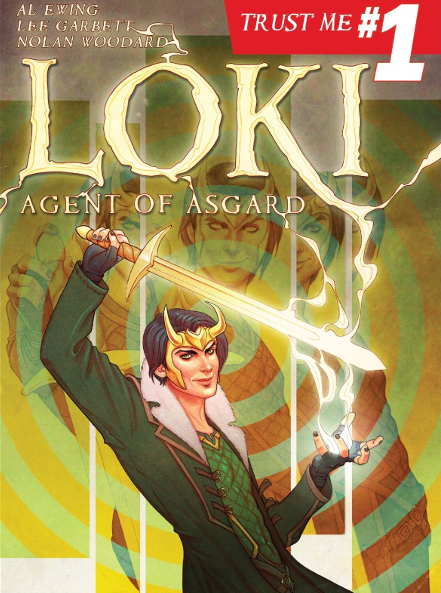
You should check out this comic if:
- You like Loki. Full stop.
- You love the mystical and mythical of the Marvel universe
- You’re a fan of capers, heists, and schemes
- You’d like to read a comic where your heart is stomped on repeatedly
You should avoid this comic if:
- You want a nice, self-contained comic — no crossovers, no heavy continuity
- You want a story without too much weird concepts and magic thrown in
- You’re looking for something nice and light to read — nothing heavy
- You much prefer action to schemes in comic books
**Warning: this comic contains spoilers for Journey into Mystery**
Al Ewing and Lee Garbett’s Loki: Agent of Asgard (2014-15) is an emotional rollercoaster of laugh out loud delight and painful tears. The successor to Keiron Gillen’s Journey into Mystery, it strikes the same witty tone and heartbreaking core, and throughout it all, it asks the question: can Loki be anything but a villain? If you’re craving more Loki after Disney+, Loki: Agent of Asgard is the answer to your withdrawal.
Loki died. Classic Loki, God of Mischief and Lies, villain and enemy of Asgard and Midgard, adopted son of Odin and brother of Thor, died. Nominally, he died saving Asgard, but truthfully he died for himself. He was reborn as the innocent Kid Loki.
Kid Loki died. God of Mischief and Lies, savior of Asgard and Midgard, adopted son of Odin and brother of Thor, died saving everything as he erased himself from existence. He died a hero. And a new Loki was reborn in his body.
This new Loki, the Agent of Asgard, is not his old self, but an echo of the Classic Loki, wearing the skin suit of Kid Loki. With the help of Wiccan the Young Avenger, Loki was aged from a child to a — very handsome — young adult.
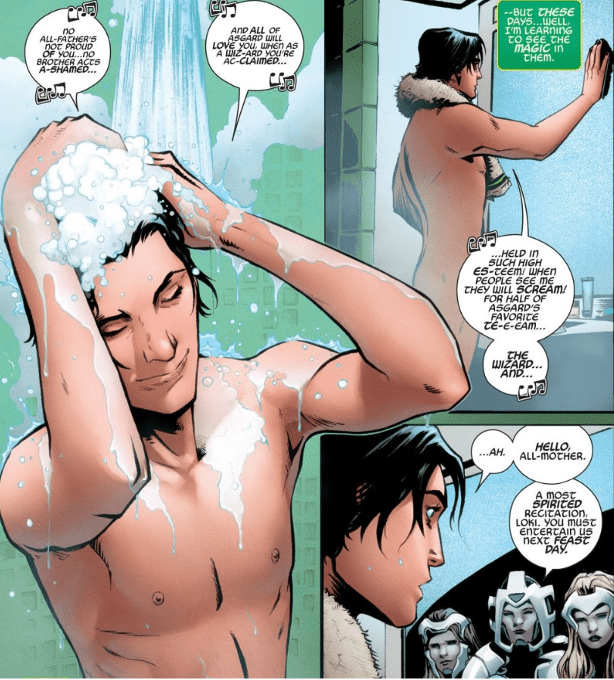
Loki serves Asgard and the All-Mother Gaea, Freyja, and Idunn, just as Kid Loki did, with his wit, silver tongue, tricks, and magic…as well as things like the internet. In exchange for his service, the All-Mother wipes away Classic Loki’s evil deeds from Asgard’s history. However, while trying to be the hero that Kid Loki was, Loki commits some not-so heroic deeds for his own interests. Not to mention the All-Mother have their own plans and schemes afoot, ones that don’t necessarily intersect with Loki’s.
Loki is still joined every now and again by his big brother, Thor, who loves him even if he disagrees with some of Loki’s methods. Yet Thor believes Loki to still be Kid Loki, the innocent child whom Thor brought back, the innocent child whom Loki killed. The truth hangs like a knife over their every interaction.
Newcoming to the comic is Verity Willis, a young woman who can always tell when someone lies — even if that someone is the god of Lies — and Loki’s new friend. There’s also Sigurd, the first hero of Asgard who is trying to avoid Asgard and the Valkyrie, and helps out Loki’s own schemes if it means being free himself. Lorelei and The Enchantress — Asgardian sisters whose magic is love-based and often oppose Thor — join Loki every now and again as he walks the grey line between hero and villain.
Loki also has with him…Loki. See, Loki is haunted by two of his past selves: the eldest self, the one who was a villain and willingly destroyed himself to become the remnant that Loki is now; and his younger self, Kid Loki, who he forced into destroying himself.
…except there is a third Loki. One that does not exactly haunt, but interferes, and one not of the past, but the future: a Loki who failed. A Loki who became the exact villain that Loki is trying not to be.

Like Journey into Mystery, the themes of trying to break free of the cycle of villainy became the basis of the Loki Disney+ series. But the four different versions of Loki and their trials are also a commentary on the nature of comics (a theme which veteran comic readers might get more out of than newbies, not to mention agree with the frustrations). In Marvel and DC, story-telling is circular, and status quo is god. The original heroes remain the original heroes, no matter who else takes up their mantle. Everyone comes back to life, no matter how absolutely for sure dead they were thistime.
And villains remain villains. No matter their redemption arcs.
Can Loki escape his designation as a villain? Or is he doomed to repeat his past self’s mistakes?
The first half of Loki: Agent of Asgard is a mishmash of arcs and adventures, while the second half is a tight-knit, emotional walloping as it brings Loki’s adventures and attempts to move beyond villainy to a close. From sheer heartbreak and pain, the series also sometimes dovetails into downright delightful absurdia, like Loki shapeshifting into a unicorn, or Future King Loki shooting a fish with a bazooka. The series also establishes Loki as canonically genderfluid, quite literally. Loki shifts pronouns as they use magic to shift their body from man to woman and back.

There’s a narration a-plenty to keep the scheming and story straight, so it’s a bit of a longer read. However, much like with Journey into Mystery, one of the downsides is the crossovers. The universe-wide crossover, Axis, interrupts the middle of the series. While it is well-done, and manages to put focus on Loki, his friendships, his character, and his relationship with Thor, you have to buy the entire collection to make sense of the full story. The second crossover, Thor and Loki: The Tenth Realm, is more like a side-book, but I count it as part of the series since it brings some emotional closure to events from issue #5 and it provides important continuity details. Meanwhile, the multiversal-wide crossover, Incursion, occurs over the last four or so issues of the series.
Lee Garbett does most of the art for Loki: Agent of Asgard, with Jorge Coelho doing a couple of the Axis crossover issues. The Tenth Realm is split between Garbett and Simone Bianchi, between the art in the regular and the art in the Tenth Realm of Heven to create a sharp divide between the two spaces. Garbett’s art is vibrant and his action is clear, with a lot of focus put on faces to ensure we know just how much emotional turmoil Loki is in.
Loki: Agent of Asgard is the comic book for any fan of Loki. It has an exceptional story that asks what it means when the world refuses to see you as nothing more than a villain. It asks what it means to write your own story, and ends on a beautiful, satisfying note that still makes me cry (good tears, mostly).
Continuity Corner: Too Many Crossovers!
Overall, even with the carryover from Journey into Mystery, Loki: Agent of Asgard has an easier continuity to follow. The series is Earth-based, rather than Asgard-based, so even newcomers to Marvel comics will see more familiar faces than not. However, Loki’s many schemes — reaching back from Journey into Mystery as well as Young Avengers — might muddle readers if you haven’t read the previous series.
The three crossovers might also complicate the story a bit. The universe-wide Axis occurs first. The Red Skull telepathically makes the world hate, and to stop him, Dr. Doom and the Scarlet Witch accidentally flip everyone’s personalities where heroes become villains, villains heroes, and grey-morality people…still grey, but in a different way. The story manages to put focus on Loki, his friendships, his character and what makes him good, along with his relationship with Thor, but it can be confusing without the entire crossover for context.
Thor and Loki: The Tenth Realm occurs between issue #5 and #6. When the Watcher is killed — a being who stands on the moon as watches events in the universe unfold — Thor discovers that there are ten realms, not nine. The comic exists thanks to some weird, behind-the-scenes intellectual property and copyright nonsense to integrate Angela, formerly a character in Image comic’s Spawn, into Marvel. If you’d like to know the complicated history behind Angela coming to join the Marvel universe, this video explains it nicely.
The story ends on a third multiverse wide crossover, Incursion, where two different Marvel comic universes — the original ones, and the Ultimate Universe one created in the 2000s — meld together. While not central to the plot, it provides a background and an impetus to the happenings as the series comes to a close.
Otherwise, characters that readers may be unfamiliar with, like Lorelei, the Enchantress’ little sister, or Valeria Richards (Sue Storm and Richard Reed’s genius daughter), get quick introductions and backstories. The series does it’s best to explain any info outside of the series to make sure new readers don’t get lost in this fog of numerous Lokis’ numerous schemes.
My Two Cents: The Second Light of My Life
I absolutely love Loki: Agent of Asgard about as much as I do Journey into Mystery. When the series began coming out, I couldn’t even wait to get a physical copy from the comic book store — I created a Marvel account just so I could buy a digital copy the day of. Apart from Walter Simonson’s Classic Loki and Tom Hiddleston’s gracious efforts for the film version, I don’t think we’ll ever get a better Loki story than the ones that Kieron Gillen and Al Ewing have given us. Now excuse me while I go buy a physical copy of the complete collection in case Marvel ever locks down my digital copies.
(And if you’ve read both series, you might want to give this article a read — it beautifully explores the themes of the Lokis’ journeys in both series, and it breaks my heart reading it almost as much as reading the series did.)
How Can I Find Al Ewing’s Loki: Agent of Asgard?
You can either get the series in one collection or four volumes — the entire collection has the Axis tie-in for a more complete reading experience. Marvel.com has the entire collection, as well as Vol. 1 “Trust Me,” Original Sin: Thor and Loki – The Tenth Realm, Vol. 2 “I Cannot Tell a Lie,” and Vol. 3 “Last Days.”
Comixology has the same selection of the complete collection, as well as Vol. 1, Thor and Loki – The Tenth Realm, Vol. 2, and Vol. 3.
Things from Another World has only the complete collection.
Remember to always check out your local library or comic bookstore first!
Enjoyed this article? Found something new to read? Say thanks by buying me a coffee on Ko-Fi! Tips are always appreciated 🙂
Images Cites From: Aaron, Jason, Al Ewing, Simone Bianchi, Lee Garbett, Szymon Kudranski and Marco Checchetto. Original Sin: Thor and Loki: The Tenth Realm. Marvel, Vol. 1, Issue 5, 2014.
Ewing, Al and Lee Garbett. Loki: Agent of Asgard, Marvel, Vol. 1, Issue 1, 2014.
Ewing, Al and Lee Garbett. Loki: Agent of Asgard, Marvel, Vol. 1, Issue 5, 2014.
Frison, Jenny. Cover Artist for Loki: Agent of Asgard, Marvel, Vol. 1, 2014.
 Comics Connoisseur