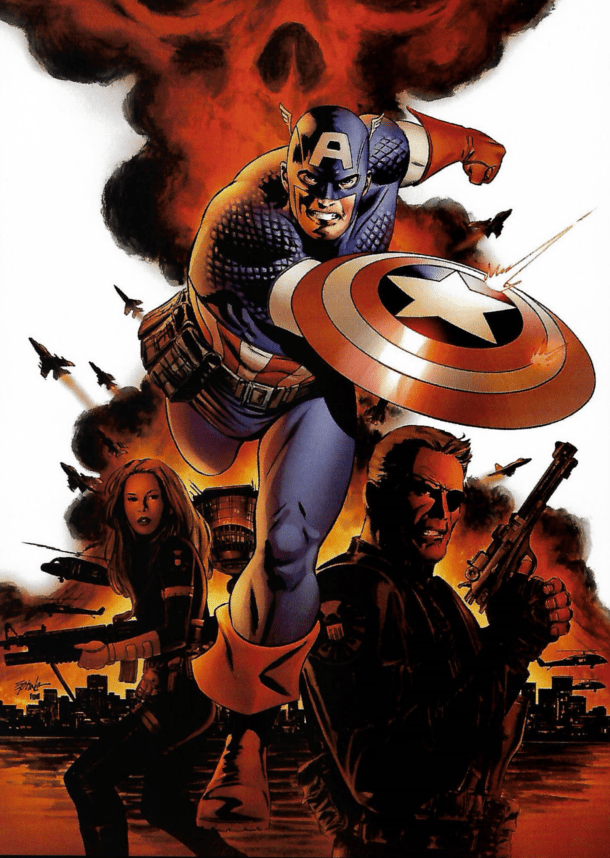
You should check out this comic if:
- You love Cap’s and Bucky’s relationship and want to see more
- You want to learn about Captain America and Bucky Barnes, without having to read a Wiki article
- You love mysteries and thrillers
- You want a darker story with high stakes — bring on the pain!
You should avoid this comic if:
- You’re tired of America-centric stories — there’s too much American saturation already
- You’re also very tired of the American military
- You want a book focused on Bucky Barnes’ recovery from his brainwashing, not just his initial trauma
- You want a comic book with a sense of fun and levity — you’re trying to find some escapism here
There used to be a saying in the comic book world: no one stays dead, except Bucky, Jason Todd, and Uncle Ben. Now, only Uncle Ben remains in his grave. Ed Brubaker’s seminal 2005 Captain America: Winter Soldier mini-series brings Bucky Barnes back from the dead in a painful noir thriller of a tale. If you want more Bucky after The Falcon and the Winter Soldier, but you don’t want to feel mired in 80 years of comic book continuity, Captain America: Winter Soldier is the perfect start for new comic readers.
In World War II, Steve Rogers was injected with a unique supersoldier serum and became the superhero Captain America. He fought in the war until he — along with his partner Bucky Barnes — fell from a bomb-loaded plane into the Atlantic Ocean. Where Bucky was presumed dead, Steve was frozen in ice and thawed out in the modern era. Cap works alongside SHIELD and his fellow heroes to protect the world from villains, costumed or not.
And right now, Steve Rogers is having a hell of a time. Haunted by the war and by those he couldn’t save, he now has to deal with the Red Skull escaping from prison. Steve is in a race against time to find him, before the Red Skull rains down bloodshed across the globe.
And then the Red Skull is killed. Long before the heroes arrive.
Accompanied by Sharon Carter as Agent 13, Nick Fury, as well as interchangeable squadrons of SHIELD Agents, Steve investigates the Red Skull’s death. It leads him across a breadcrumb trail of mysteries, mayhem, and murder, to a man he thought long dead: Bucky Barnes
James Buchanan“Bucky” Barnes joined the war effort at 16 as Cap’s sidekick. He fights by his side with others like the original android Human Torch, in inflammable Toro, and Namor the Sub-Mariner.
An expert in hand-to-hand combat and with special ops training, Bucky made an effective teammate despite his lack of superpowers — retconning the bright, colourful 1940s version of the character to an in-universe propaganda tool. Through the war, he and Steve became partners and best friends, and his (assumed) death was a devastating blow to Steve when he woke from the ice.
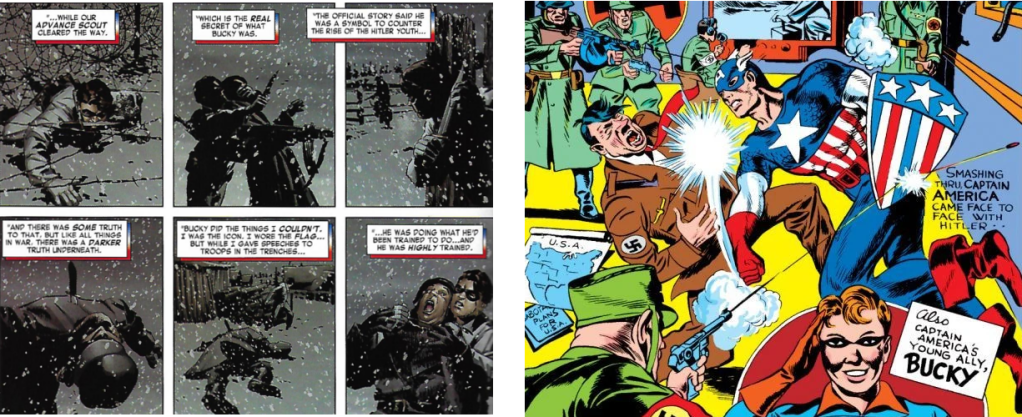
If you know anything about Bucky Barnes, you know the story of the Winter Soldier — the young hero turned brainwashed assassin.
But it doesn’t matter that you know the twists. What matters is the relationship between Steve and Bucky — their past friendship and their present anguish. It’s about Steve’s pain as he learns what happened to his friend, and what he’s been doing all these decades. It’s about Bucky’s pain, as he is turned into the perfect assassin against his will. It’s about Steve deciding: is there anything left of his friend? Can he save him, or will he be forced to kill him?
To cover Steve and Bucky’s past relationship during the war, flashbacks saturate the story. The series treats the war with gravity and respect — muting the colour palette to black and white. The flashbacks even have a different artist — Michael Lark — to further separate them in tone from the rest of the comic. Despite the superheroics, the series doesn’t treat the war with the usual comic book antics.
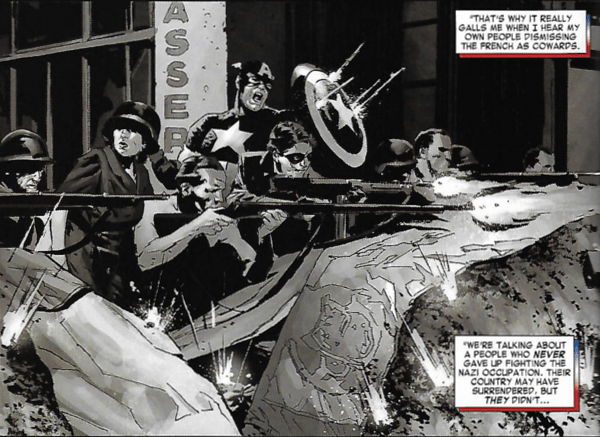
But as painful as the story is, if you’re looking for the type of therapy seen in The Falcon and the Winter Soldier, this might not be the comic for you; Bucky is in the midst of his trauma here, not recovered from it. Also, where Sam Wilson’s Captain America problematizes American military control to some extent, Captain America: Winter Soldier has little to say about it, and at times endorses it. Rarely thinking about the political orbit, this comic series focuses on the emotional core of Steve and Bucky, and damn the political consequences.
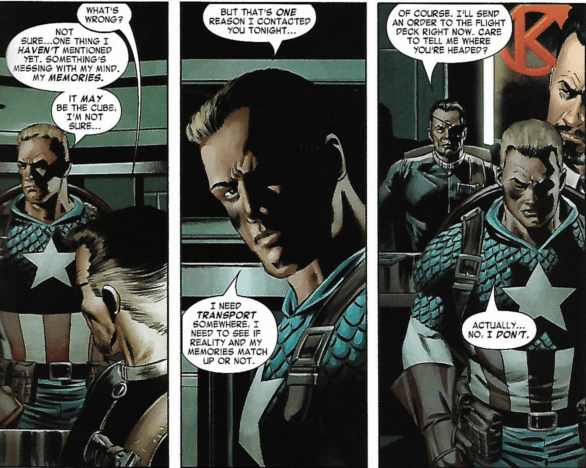
Steve Epting is the main artist, maintaining a consistent tone across the series. The exceptions, such as the war flashbacks and an issue focusing on a side character drawn by John Paul Leon and Tom Palmer, create a distinct narrative space separate from Cap’s present.
Epting’s art is often plain and muted, with quite a few panels focusing on action and fight scenes without dialogue. Unfortunately, faces aren’t always depicted as well: Epting’s faces are often in chiaroscuro lighting, which elevates the noir mystery tone, but makes it hard to see people’s expressions.
Part war epic, part action-spy thriller, and part horror story, Captain America: Winter Soldier is the modern touch-stone for Steve and Bucky’s relationship. Even if it’s a tale you’ve heard before, it’s worth the read just for the emotional ride.
Continuity Corner:
Captain America’s and Bucky’s history is rather convoluted, thanks to poor comic book sales and retconning in the sixties. Captain America and Bucky actually continued well into the post-war era. However, to drum up more interest, the Cap and Bucky who survived the war were established as imposters, with the real Cap and Bucky retconned into falling from an exploding plan just before the end of the war. The real Captain America was only revived in Avengers #4 in 1964, while Bucky Barnes remained dead…until 2005..
Captain America: Winter Soldier eases that confusion by rewriting Cap’s earlier history to move it away from the campiness of the comics in the 40s — back when Cap was introduced in 1941 punching Hitler in the face. The new continuity makes this comic a fresh start for anyone entering the Marvel Universe.
It is also a very contained story, focusing on Steve’s history as opposed to the Marvel Universe at large. It explains the history of Captain America and the men who have worn the costume across the years, giving you all the backstory you need to understand Captain America.
If you’re coming in from the films, there’s only a few differences to take into account. For example, the Cosmic Cube has no connection to the Infinity Stones. Each Cube (yes there’s more than one) is a reality-altering entity that has been coveted by many bad guys across the years, the Red Skull being the main one. The only other big event tied in is Avengers Disassembled, where — as the name suggests — the Avengers ended up disassembling for a while.
Otherwise, Captain America: Winter Soldier makes it easy for readers who don’t want to constantly open a Wiki article. It’s the idea comic book for new readers to start with and delve into the modern Marvel universe
My Two Cents:
I found this comic book series early in my ventures to explore the wider Marvel Comic Universe. Despite my reservations about the American-ness of Captain America comics, the intense and emotional story gripped me. It’s a high recommend from me, no matter how many times you might have watched the film version.
How Can I Find It?
This comic book series is unfortunately harder to find, despite being such an iconic read.
You can get the entire series at Marvel.com or Comixology.
For physical copies, you can also check out Amazon and Barnes and Noble.
But check your library or local comic book store first! Amazon should be your last resort.
Enjoyed this article? Found something new to read? Say thanks by buying me a coffee on Ko-Fi! Tips are always appreciated 🙂
Images Cites From: Brubaker, Ed, and Michael Lark. Captain America: Winter Soldier, Marvel, Vol. 1, Issue 3, 2005.
Brubaker, Ed, and Michael Lark. Captain America: Winter Soldier, Marvel, Vol. 1, Issue 5, 2005.
Brubaker, Ed, and Steve Epting. Captain America: Winter Soldier, Marvel, Vol. 1, Issue 5, 2005.
Epting Steve. Cover Artist for Captain America: Winter Soldier, Marvel, Issue 1, 2005.
Kirby, Jack. Cover Artist for Captain America, Timely Comics, Vol. 1, Issue 1, 1941.
 Comics Connoisseur