You should check out this comic if:
- You want superheroes to actually fight injustice, not just aliens or supervillains
- You want a story that keeps its forward momentum to build an overarching, character-driven plot
- You love the weirdness and wackiness of superhero universes
- You have a fondness for stories are a bit of an ensemble, rather than focused on one main hero
You should avoid this comic if:
- You’re tired of America-centric stories — there’s too much American saturation already
- You want political issues to get out of your comic issues!
- You prefer your comics to be grounded in regular superhero fantasy — nothing too weird
- You’d prefer a story focused on Sam Wilson and only Sam Wilson
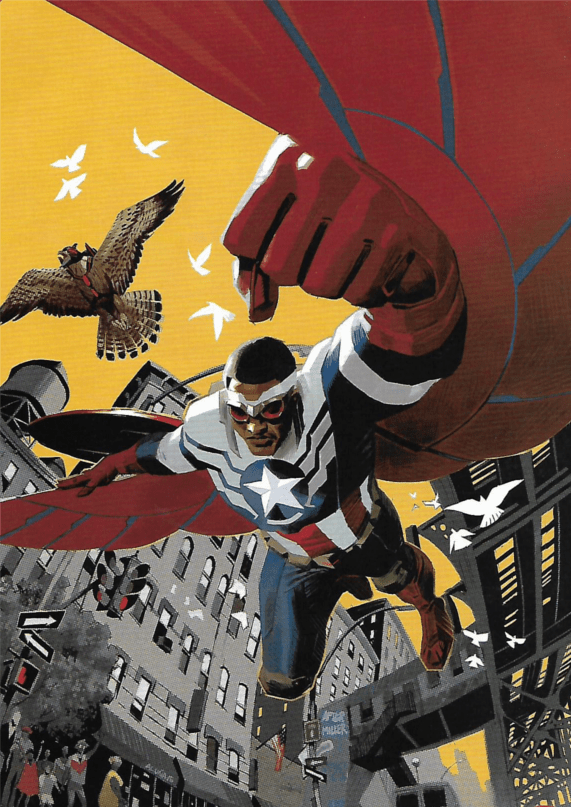
The politically-charged Captain America: Sam Wilson is an indictment of the American right, while still having fun indulging in superhero wackiness. Sam Wilson is a Black man trying to be a symbol of a nation divided — specifically one divided on Sam taking up the Captain American mantle and shield. If Falcon and the Winter Soldier didn’t provide enough of Falcon’s turn as Captain America, you’ll find five volumes worth in Nick Spencer’s 2015-2017 run on the series.
Sam Wilson, formerly the Falcon, took over as Captain America when Steve Rogers was expunged of his super soldier serum and aged into an old man. Though lacking Steve’s super soldier strength, Sam also has abilities Steve never had: Sam’s iconic Falcon wings, the ability to psychically talk to birds, and a unique psychic link with his pet falcon, Redwing (who also happens to be a vampire).
Kicked out of SHIELD for controversial political opinions, Sam must fight his battles without the backing of the government, military, special forces, or anything else that would make jetting around the country easy. Steve Rogers, though still Sam’s friend, is on the outs with him for their differing views on America and dicey morally grey issues. Sam sees a side of America that Steve never will. Steve trusts in the system, the American people, and the American justice system, more than Sam ever could.
But the new Cap isn’t alone in his fight. By his side are Misty Knight (former detective and one half of the martial arts duo Daughters of the Dragon), Dennis Dumpy (a former wrestler turned hero), and the mysterious Whisperer (a hacker/whistleblower).
Sam is later joined by his own Falcon, Joaquin Torres; Joaquin was a good Samaritan who used to help Mexican border crossers before he got abducted by a mad scientist and had his DNA merged with Sam’s falcon, turning him into a bird-man. Later Elvin Haliday — better known as Rage — uses his superstrength to eponymously rage against oppression. However, his aggressive tactics make him more of a frenemy to Sam than a true ally, at first. Both young men represent the younger, angrier side of the fight against discrimination and oppression, and neither are as willing to compromise as Sam Wilson.
The series comes out of the gate swinging at the inequality in America — a thinly veiled version of Trump’s America and white supremacism that arose during his run for office and years as president. Racism, immigration issues, capitalism, police brutality, and more left-wing stances take their time to shine in each storyline.
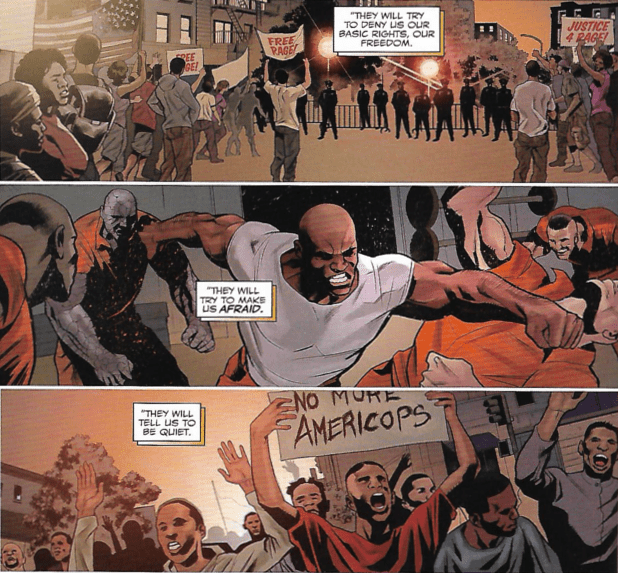
While there are supervillains like the Serpent Society (rebranding themselves as the corporate Serpent Solutions), or Baron Zemo and the U.S Agent, Sam’s biggest fight remains injustice. Cap struggles with the injustice of the way corporations exploit the lower class, to the injustice of a corrupt SHIELD leader escaping the law, to the injustices Black people face every day at the hands of the police.
Usually the issues are pertinent, the situations nuanced, and the oppression rage-inducing, However, the series stumbles at times, and the political issues aren’t always necessarily handled well.
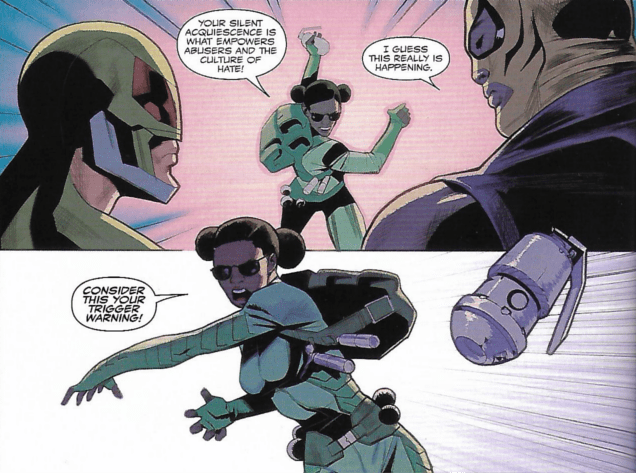
Each issue takes its time to build up across the series as Sam confronts each in turn and has to deal with the injustice still so present in America — and still so immovable, so difficult for even Captain America to tackle. Sam must find out: what is his breaking point? Where is the line, where compromise and peace mean siding with perpetrators rather than making a real difference? When does compromise cost too much?
But the series isn’t all doom and gloom, and Captain America: Sam Wilson isn’t afraid to get weird. Thanks to a mad scientist combining people’s DNA with animals, Captain America briefly becomes Cap-Wolf. Kraven the Hunter has a tea-party with a reality-altering being that has evolved itself into a four-year-old girl.

The series embraces the zaniness of Marvel comics’ history and incorporates it into the story with little aplomb.The comic book fun balances the seriousness of the real life problems it faces. However, if you’d prefer the series maintain its gravity in face of the real life consequences, you might find the fantasy fun insensitive to the topics.
You also might be disappointed if you wanted the series to give Sam Wilson his time to shine alone. Each of his friends get their own spotlight, turning the book into more of an ensemble piece at times. If you’re a fan of the original Captain America, Steve Rogers features prominently; he and Bucky Barnes get almost equal page space with Sam in issues #7 and #8.
Artists come and go on Captain America: Sam Wilson. If you don’t like one of the artists’ styles, don’t worry! The series doesn’t stick with it for long. What matters is that the action and movement is clear. Unfortunately, despite the different artists, women consistently get the short end of the stick: they are often drawn with model figures, skin-tight or ultra-revealing clothes, sexy poses, and lots of boobs and butt shots.
Despite the rocky handling at times, Captain America: Sam Wilson is entertaining from start to finish. You’ll rage — and perhaps cry — at the injustices perpetrated, while still giggling at its comic book absurdity. If you found that Falcon and The Winter Soldier kept pulling its political punches, you’ll be relieved by Captain America’s refusal to never let political injustice fall by the wayside.
Continuity Corner:
Despite Sam Wilson’s over fifty-year history in Marvel Comics, the series does its best to make itself accessible to new readers.The first two issues catch up readers in a brief history of Captain America, Sam Wilson, and Sam becoming Cap. And while there are a great many villains and events over Marvel comics’ history brought in, readers always get a quick background.
Sam Wilson first appeared in a Captain America comic in 1969, and is Marvel’s first African-American superhero. A social worker who is also good with birds (he had already trained his pet falcon, Redwing) Sam met Steve Rogers during one of the Red Skull’s schemes. During that scheme, Red Skull’s use of the Cosmic Cube gave Sam the ability to telepathically communicate with birds. Later he received his first set of mechanical wings from Black Panther, completing his transformation into the superhero the Falcon. He has spent most of his time in Captain America comics, though he’s been on a few Avengers teams here and there.
Since Sam is an Avenger during the Captain America: Sam Wilson, the comic series ties in some of the happenings in the Marvel universe at large, namely Civil War II, as well as sideline into a larger Avengers fight (fully covered in vol. 2). The second volume also celebrates 75 Years of Captain America, so the focus leaves Sam for Steve, Bucky Barnes, and the Avengers for that volume.
However, there are references to previous events in Marvel history thrown in that don’t get the same coverage: Incursion (two different Marvel comic universes melding together); the first superhero Civil War (superheroes fighting about whether or not they should register with the government); and even CapWolf (when Steve Rogers became a werewolf briefly).
If you’re coming in from the films, there’s also a few differences to take into account. For example, the Cosmic Cube has no connection to the Infinity Stones. Each Cube (yes there’s more than one) is a reality-altering entity that has been coveted by many bad guys across the years, and the Cubes tend to evolve into sentient beings eventually. SHIELD has also not been Hydra all along…but that doesn’t mean a secretive and powerful military organization with night-unlimited resources and little oversight is good.
But don’t worry if you don’t have encyclopedic knowledge of Marvel’s stranger stories — readers always get a quick background intertwined with narrative, or the narrators’ thoughts. You might miss the reference to Hostess Fruit Pies, but the comics will give you all that you need to know for the story
If you’re looking for an introduction to the Marvel comic universe at large, Captain America: Sam Wilson is the perfect series to dive into and familiarize yourself with the zaniness of superhero comics. But if you want to take things a bit slower, you may want to start with some older comics first.
My Two Cents:
The Captain America comics aren’t generally my wheelhouse. As much as I love Chris Evan’s Cap in the films, there’s a lot of…American-ness and specifically American military-ness present in Cap comics. It’s a little much for my Canadian sensibilities. But Captain America: Sam Wilson blew my reservations out of the water. Sure, I didn’t like every single issue, nor the handling of every issue in those issues. But I still had a blast and was right there along with Sam, raging against the injustice of a broken, uncaring system.
How Can I Find It?
Captain America: Sam Wilson has 21 issues, but due to the Avengers tie-in in issues 7 and 8, it’s better to read the volume collections to get the fuller story.
At Marvel.com, you can find all five volumes in hardcover form: Volume 1 “Not My Captain America,” Volume 2 “Standoff,” Volume 3 “Civil War II,” Volume 4 “#TAKEBACKTHESHIELD,” and Volume 5 “End of the Line.” You can also find the series collected in two larger volumes with more tie-in comics here and here.
Things from Another World also has all five comic volumes, currently on sale.
If you want a digital copy, Comixology also has all five volumes and the two volumes of the complete collection.
Of course, check out your local library or a comic store near you before resorting to multinational corporations!
Enjoyed this article? Found yourself your new favourite comic book? Say thanks by buying me a coffee on Ko-Fi! Tips are appreciated, never expected 🙂
Images Cited From: Acuña, Daniel. Cover Artist for Sam Wilson: Captain America, Marvel, Vol. 1, 2015.
Spencer, Nick, and Daniel Acuña. Sam Wilson: Captain America, Marvel, Vol. 1, Issue 3, 2015.
Spencer, Nick, and Paul Renaud. Sam Wilson: Captain America, Marvel, Vol. 4, Issue 17, 2017.
Spencer, Nick, and Paul Renaud. Sam Wilson: Captain America, Marvel, Vol. 5, Issue 20, 2017.
 Comics Connoisseur
[…] be the comic for you; Bucky is in the midst of his trauma here, not recovered from it. Also, where Sam Wilson’s Captain America problematizes American military control to some extent, Captain America: Winter Soldier has little […]
LikeLike
[…] and it doesn’t go out of its way to fully explain certain characters like Mephisto or Tyr as Captain America: Sam Wilson did; however, it does fully explain Loki’s past schemes and how they are relevant to the present […]
LikeLike