You should check out this comic if:
- You like suspense novels, mysteries, and thrillers.
- You like thoughtful stories on the nature of humanity — or humanity-adjacent beings.
- You like a tight, contained story that doesn’t require a large reading load of a series.
- You like comics that forgo the world-ending sprawling battles for smaller, emotional ones.
You should avoid this comic if:
- You want real action! Where are all the big superheroes battles?
- You want something light and easy to read — you’re in the mood to relax.
- You don’t like realistic depictions of violence — and you especially don’t like depictions of violence against children and animals.
- You’re not a fan of darker takes on superheroes.
The 2015-2016 The Vision miniseries is a masterful demonstration of storytelling and suspense. Written by Tom King, with art by Gabriel Hernandez Walta and Michael Walsh, the Eisner Award-winning series questions whether a synthetic man can really be human, or just an imitation. Where last week, we looked at Wanda Maximoff, this week we’re looking at the second half of the WandaVision duo: The Vision.
Vision is a synthezoid, a synthetic being that — unlike an android or robot — has synthetic tissue and organs based on a human’s. He even has human brainwaves, provided by the superhero Wonder Man. Apart from the superstrength and superintelligence granted by his artificial body, Vision can also fly, use solar energy to create a powerful energy beam, and change his density to phase through objects or become utterly immovable.
But right now Vision is facing a challenge that shouldn’t require his superpowers: he is starting a family.
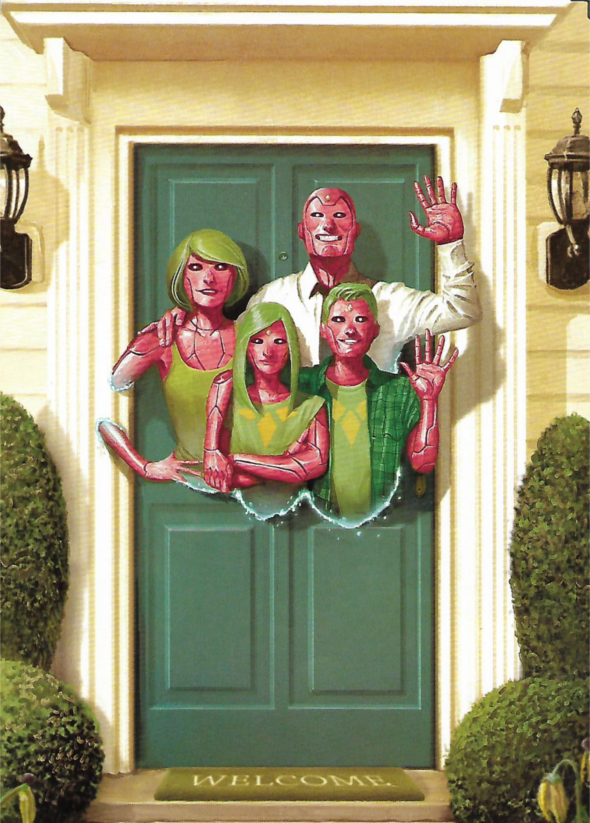
Unlike with his previous attempt at starting a family with Wanda Maximoff, Vision’s new family isn’t human. They are fellow synthezoids like himself — ones created specifically for this purpose. His wife Virginia has pre-loaded brainwaves from a human, like Vision. Meanwhile, his children’s minds — his daughter Viv and son Vin — were formed from a combination of Vision’s and Virginia’s brainwave patterns, resulting in synthezoids similar to human teenagers in that they still need to grow and mature. All three share Vision’s powers and abilities, making for one powerhouse of a family.
The Visions settles in the suburbs of Arlington, Virginia, among regular people — full of white picket fences and heteronormative couples with 2.5 kids. The comic opens with two of their neighbours bringing the family cookies, debating how real and human The Visions really are.

As the neighbours leave a few pages later, we are told by what seems to be an omniscient narrator that the neighbours will die in flames. And one of The Visions will set the fire.
Which one will kill their neighbours? Vision, the hero, the Avenger? Virginia, the wife with the preloaded memory? One of the children, saddled with teenage brains, who must endure school surrounded by teenagers who may be more cruel than adults?
At times darkly parodying 1950s family dynamics, the series racks up a serious body count. The first death in the series occurs only one issue in.
Continually, the narrator drops pieces of the disastrous future, shaping the impending doom caused by the Vision family’s presence. The comic makes no secret from the beginning that this test — this social experiment — will end in disaster: the Visions’ attempt to live among humans, to be human, will have fatal consequences.
Since this is the Marvel universe, where mutants and metahumans are references for real life minorities like people of colour and the queer community, the Vision family is no different. Of course, neither people of colour nor queer people cannot shoot lasers from their heads or crush a car with their bare hands, as in the case of the Visions. Still, King works in parallels of discrimination where and when he can.
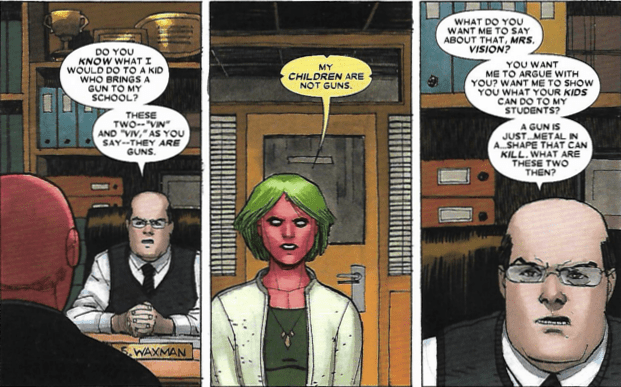
More explicitly, the series brings up real life discrimination: the school the children attend recently changed its mascot from the “Fighting Redskins” to the “Fighting Patriots”, but haven’t changed all their logos of racist caricature of an Indigenous man; there’s the classic speech from Shylock in The Merchant of Venice intercut with significant panels to parallel the Vision family’s own battle to be recognized as people. The Visions may not bleed if pricked, but they do feel pain, heartbreak, guilt, love, and anger like any human.
Unlike last week’s Scarlet Witch, The Vision deals with Vision’s relationship to Wanda Maximoff, even if the two of them are not together. Various members of the Avengers also appear in the series, especially as the violence escalates and Vision’s superhero friends and allies wonder about, too, the extent of The Visions’ humanity.
Superhero-typical battles are sparse, and the violence is brought down to earth — punches have serious consequences. The violence is realistically shown in full, bloody, gory detail, rather than the superficial cuts and bruises that normally result from comic book battles.
Walta’s art is similarly realistic and plain, if rather simple — the angles aren’t particularly creative, and the panel placement is more reminiscent of cartoon panels rather than comic panels; however, the simplicity, along with the muted colour palette, better suits the tone and themes. Despite the presence of synthezoids and magic, the series isn’t meant to be fantastical.
However, it may be upsetting for readers adverse to gore, blood, violence. Violence and death — including the death of children and animals — are brutally brought to life through Walta’s art. If those things make you squirm, it’s best to give this one a pass.
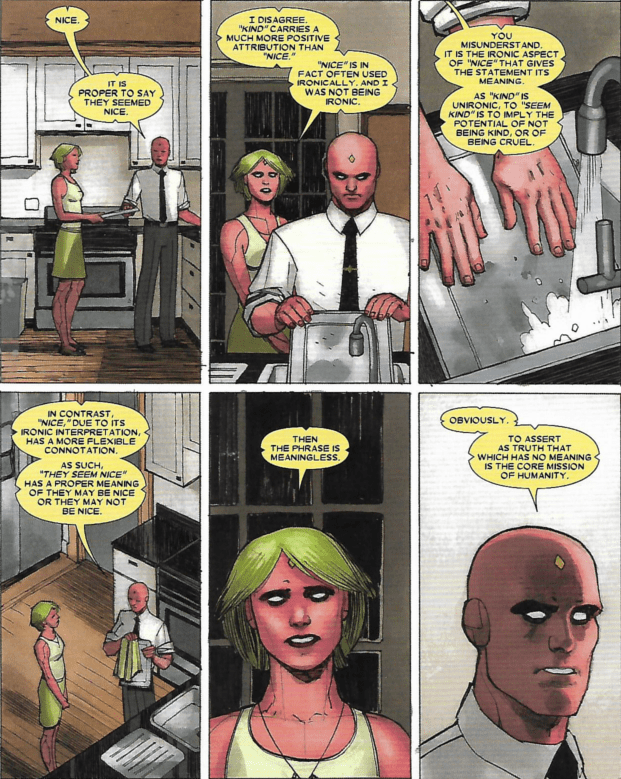
The Vision family’s dialogue is appropriate to several machine-like beings having a debate — as in, they sound like a mix of philosophy and English majors who look for what is most logical. It is also not the quickest or easiest read because The Vision family and narrator also often have debates that are metaphysical, philosophical, or mathematical in nature. Sometimes there are even three dialogue boxes going at once — the narrator, and two characters in conversation — so this isn’t a comic you can slack off on.
I can’t say much more about the series without heading into serious spoiler territory, and like with any good thriller, you’ll want to discover the twists for yourself.
Despite the darker themes — perhaps because of the darker themes — The Vision is a masterful form of tight, suspenseful storytelling, doubling as a meditation on limits of humanity. It keeps you on your toes and is more than happy to make you cry. For readers who don’t just want a superhero story, but a story that runs you through a gamut of emotions in only twelve issues, The Vision is perfect if you.
Continuity Corner:
The comic snatches up bits and pieces of the Marvel comic universe without delving too deep into any lore. Readers are given all the relevant details of these characters’ backstories to fully understand their thematic resonance with the Vision family. The second volume even delves more into Vision’s history with Wanda and the Marvel Universe, helping to set up how he arrived at this point.
If you’re coming to this comic from the films or WandaVision, Vision’s backstory is quite a bit different from his MCU counterpart. While both were created by Ultron with the intent of destroying the Avengers, and then later turned on Ultron, the comic’s Vision has no relationship to Tony’s Stark’s AI, Jarvis. Instead, Vision’s mind was based off of that of Simon Williams, aka Wonder Man, a superhero and sometime actor.
Vision has been an Avenger for most of his existence, and most of his romantic entanglements have been with Wanda Maximoff. Previously, the two of them had been married for some time, with two children resulting from the marriage. However, it was revealed those children weren’t real but created through demonic magic, and were erased from existence; around the same time, Vision was captured and dismantled, and though he was reassembled, his emotions were wiped. The two events led to Wanda and Vision’s split. While their relationship has had some ups and downs since then, the former couple remain on good terms during The Vision miniseries.
While entry readers into the Marvel universe may not get the same thorough understanding of themes as veteran readers, the comic explains all the relevant connections and backstory needed. The details are woven in as their thematic connections come up, never once losing readers in a fog of continuity. Be as prepared for magic as for robots, and you’ll get along fine.
My Two Cents:
There are only twelve issues in this miniseries, making it very simple (and cheap!) to read. You can find Volume 1 “Little Worse Than A Man,” and Volume 2 “Little Better Than A Beast,” at Marvel.com, or buy the entire collection.
You can also find both Volume 1 and Volume 2 at Comixology if you want a digital copy.
As always, check out your local retailers or library first before looking at the Disney/Amazon mega-corporations!
Enjoyed this article? Found something new to read? Say thanks by buying me a coffee on Ko-Fi!
Images Cited From: Del Mundo, Mike. Cover Artist for The Vision, Marvel, Vol. 1, 2015.
King, Tom, and Gabriel Hernandez Walta. The Vision, Marvel, Vol. Issue 1, 2015 and Issue 2, 2015.
 Comics Connoisseur