You should check out this comic if:
- You’re a fan of complex, well-written female characters.
- You like comics that experiment with their artwork — the funkier the better!
- You want to see a female character dealing with her trauma and mental health.
- You wished more feminist stories included women relying on other women.
- You want a story that focuses on the story — punching people doesn’t build character.
You should avoid this comic if:
- You like nuanced, complex villains.
- You think the trope of woman = good, man = bad in feminist stories is tired and overdone.
- You want a nice long juicy story arc — not short, contained stories.
- You like Pietro Maximoff and his relationship with Wanda.
- You want a superhero story stuffed with action — that’s the point of superheroes.
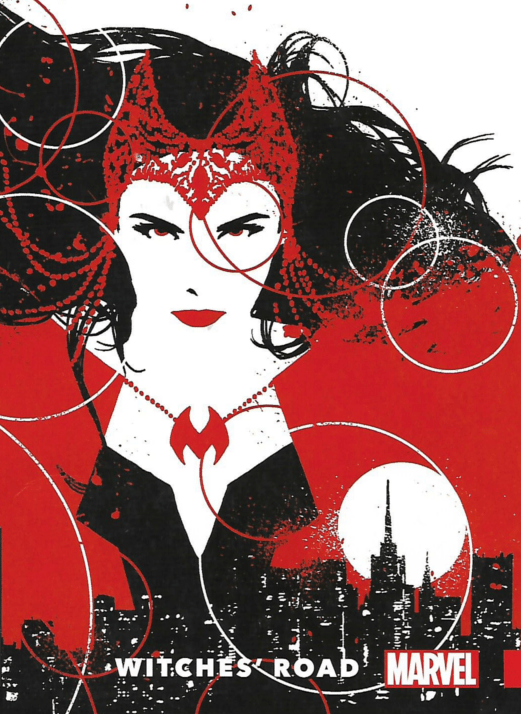
The 2015-2017 Scarlet Witch miniseries gives Wanda Maximoff room to breathe. As she deals with her past and future, legacy and heritage, Wanda finds who she is beyond her life as an Avenger. If you were a fan of WandaVision and wanted to see more of the Scarlet Witch coming into her own power, you’ll be hooked by writer James Robinson and the bevvy of artists that take Wanda through her journey.
Wanda Maximoff is a witch and an Avenger, a one-time villain turned hero, a Roma woman who once believed herself a mutant. Always part of a team, whether the Mutant Brotherhood of Evil or one of the various Avengers, she now strikes off on her own. Her mission? Save magic.
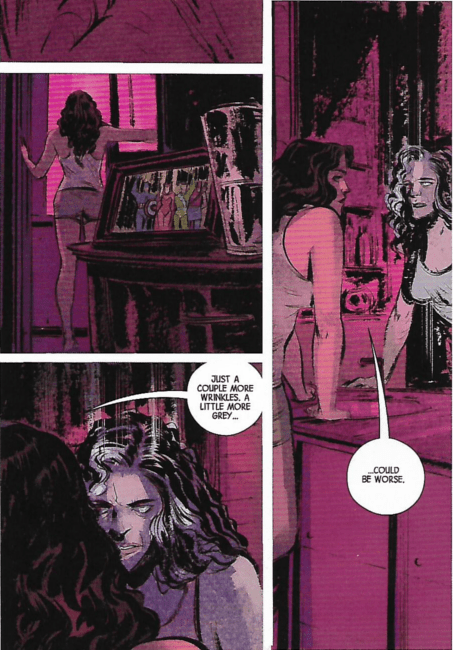
Magic is sick, you see — much like Wanda herself. Wanda’s use of magic is slowly aging her soul, represented every now and again by her aged self’s reflection in the mirror.
By her side is the ghost of Agatha Harkness, the sometime-mentor of Wanda, who was killed by Wanda herself during one of her periods of mental instability. Without too many hard feelings about it, Agatha now stands by Wanda’s side as they discover who — or what — is harming magic.
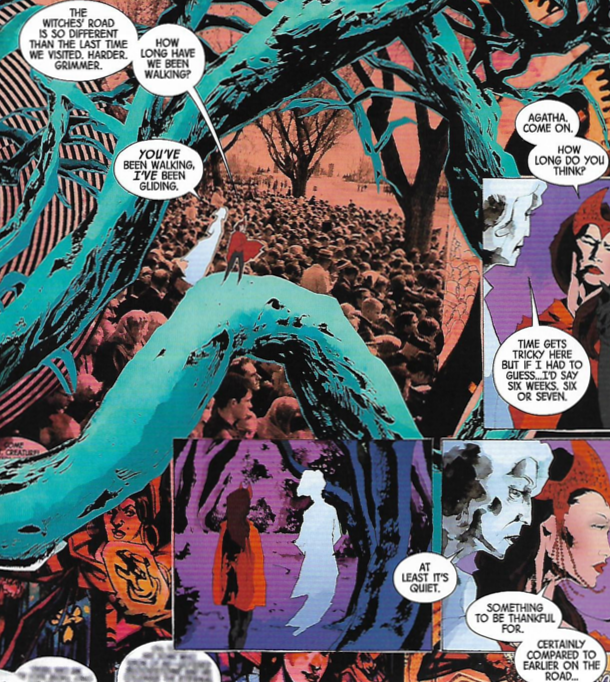
However, the main plot is only truly dealt with when Wanda enters the mystical, magical, time-bending space of the Witches’ Road.
Instead, the plot is a vehicle to take Wanda across the world — from New York City to Greece, to Ireland, to France — as she helps the magic, women, and magical women in each location, and is helped in turn. Rather than a unifying plot, the themes of witchcraft, feminism, family legacy, trauma, and healing bind Scarlet Witch together. Often, these themes are told through the people Wanda meets on her journey as much as through herself:
Wanda questions what it means to find atonement and healing — and the difference between each, especially when Wanda has hurt people in her pain; in the Spanish countryside, Wanda finds the ghost of a young novice nun causing possessions, still angry after hundreds of years from the injustice of her and her fellow novices being burned at the stake during the Spanish Inquisition. Wanda questions what it means to carry on the legacy of her Roma family and a mother she never knew, Natalya Maximoff — the previous Scarlet Witch; in Hong Kong, Wanda works with a sorceress/police-woman who calls herself The Wu, who must also carry on her own mother’s legacy of witchcraft while being true to herself and her calling.
The short stories and the mini-villains of each issue means that, until the final battle in the last few issues, these villains are often dealt quickly and perfunctorily. If you’re looking for dynamic stories, worldbuilding, and an exploration of the wider Marvel Universe beyond NYC, you’ll find the stories and character snippets immensely intriguing; however, if you’d like a longer resolution and more time with a place or a character, you might find these stories moving too fast.
You’ll also be disappointed if you’re a fan of Wanda’s relationship with Pietro Maximoff, The Vision, and the rest of The Avengers. There’s an issue dedicated to Wanda and Pietro in a clumsy tie-in to the 2016 crossover event, Civil War II. In the issue, Pietro is at his most paternalistic, and physically tries to harm Wanda to force him to see his point of view. Otherwise, the Avengers are only mentioned, or appear as fragments of Wanda’s past.
The new artist for every issue serves the story rather than making it feel incohesive. As Wanda moves from place to place around the globe, each artist paints the location in their own style, giving it their own character and feel. Wanda herself is a woman dealing with a complicated past, and the art speaks to Wanda’s shifting identities.
The more creative art serves the magical space of The Witches’ Road, creating an eerie, convoluted, off-kilter space that really feels like it doesn’t obey the laws of time and space.
Unfortunately, despite the feminist story, several of the issues are mired in the male gaze, with breasts arched sexily or the female body contorted in ways to make it the most appealing. Nor do all the intricate art styles serve the story, with some being downright confusing.

Overall, Scarlet Witch isn’t about the superhero battles, or the villains. It’s about Wanda and her journey. The series is a feminist tour de force in showcasing Wanda’s talent, while never falling into the “not like other girls” trope nor degrading the women who help her, whether they be a goddess or a nun. If you are looking for a story of a woman recovering from her complicated past, a story of women supporting each other, then this story is for you.
Continuity Corner:
As with any Marvel comic book character who’s been around since the 1960s, the Scarlet Witch’s past is incredibly convoluted and consistently retconned (her parentage has been changed about three times).
However, Scarlet Witch does it’s best to catch readers up, so you don’t need an encyclopedic background knowledge of her character to understand the story. You may miss some of the nuance in earlier issues, but the comics inform you of important events along the way. One issue even centers around Wanda’s visit to a therapist, which doubles as a way to catch up new — or simply forgetful — readers up on Wanda’s history and the various traumas she now has to deal with.
Wanda started out briefly on Magneto’s Brotherhood of Evil Mutants with her brother Pietro before joining the Avengers. Later, she married The Vision and had two children who were subsequently revealed to be created through magic. The “fake” children proceeded to be wiped both from existence and from Wanda’s memory.
It is the loss of her children that leads Wanda to her need for redemption in Scarlet Witch. In the comic book events Avengers Disassembled and the following House of M, Wanda loses her grip on reality after remembering what happened to her children. Unknowingly influenced by outside forces like Dr. Doom, she accidentally kills a few Avengers, and then wipes out most of mutant-kind’s powers, rendering them human.
If you’re just entering the comics from the films or WandaVision, you might have to do some readjusting as you get used to the difference between the two universes. But the series helps you hit the ground running so you aren’t left behind, dazed and confused. Just be ready to accept some pretty weird stuff — it’s a staple of superhero comics.
My Two Cents:
To be truthful, I personally didn’t enjoy this series. While Wanda Maximoff is one of my favourite characters, I found the repeated dichotomy between female = good, male = bad to be boring, unenjoyable, and too reliant on the gender binary. It’d be one thing if it was just patriarchal = bad, which is a message I’m always behind — but there’s no room for such nuance.
More than that, I find that female-led properties are an excellent place to also include complex female villains. Not only are many villains in this series one-note straw-misogynists, there are no major female villains.
I also do quite enjoy Wanda’s relationship with the mainstays of the Marvel universe, including her brother and The Vision, but those relationships aren’t looked upon kindly in Scarlet Witch.
However, even if I don’t like it, you might.
How Can I Find It?
There are only three volumes to Scarlet Witch: Vol. 1 “Witches Road” (2016), Vol. 2 “World of Witchcraft” (2017), and Vol. 3 “The Final Hex” (2017).
You can buy the entire collection from Marvel.com, or buy it individually: Comixology has Vol. 1, Vol. 2, and Vol. 3 for about $9.00 each. However, if you’d like to avoid an Amazon-affiliated company, Things From Another World has Volumes Two and Three.
As always, don’t forget to check out your local comic retailer, or save yourself $20.00 and hit up your local library first!
Enjoyed this article? Found something new to read? Say thanks by buying me a coffee on Ko-Fi! Tips are always appreciated 🙂
Images Cited From: Aja, David. Cover Artist for Scarlet Witch, Marvel, Vol. 1, 2015.
Robinson, James, Jonathan Mars-Barravecchia, and Rachelle Rosenberg. Scarlet Witch, Marvel, Vol. 3, Issue 13, 2016.
Robinson, James and Marco Rudy. Scarlet Witch, Marvel, Vol. 1, Issue 2, 2016.
Robinson, James, Vanessa Del Ray, and Jordie Bellaire. Scarlet Witch, Marvel, Vol. 1, Issue 1, 2015.
 Comics Connoisseur